Fusion Equilibrium Challenge — the Anulum entry
The permanent record of one entry to the Fusion Equilibrium Challenge (NeurIPS 2026, organised by Sophelio): reconstructing the poloidal flux map of a tokamak plasma, and q95 and βN, from coil currents and Thomson-scattering profiles alone, without any magnetic measurement.
The entry has two parts that share nothing but the task:
- DIII-D: an ensemble of networks trained on the organisers’ labelled DIII-D shots, followed by a finishing step that edits each predicted map towards predicted shape targets (Methods §2).
- MAST: a physics reconstruction frame by frame. No model is trained on MAST and no constant is fitted to MAST equilibria; public MAST scores were used to compare pipelines, with disclosure (Methods §3). “Zero-shot” means exactly this; it is not the DIII-D model transferred to a second machine.
Result
Development phase, public test folds, submission 986068 (14 October 2026); 11th at the close of the Development phase. The blind Final was submitted on 19 October 2026 (Codabench 1003274); its result is added here when it is published.
| DIII-D | MAST | |
|---|---|---|
| Benchmark score S | 0.996359 | 0.714450 |
| Flux map R² | 0.999883 | 0.979450 |
| q95 and βN R² | 0.998005 | 0.330685 |
| Boundary distance D_LCFS | 0.008180 | 0.191791 |
| Consistency of derived scalars | 0.987704 | 0.226646 |
S = 0.55 R²ψ + 0.15 R²{q95,βN} + 0.10 (1 − D_LCFS) + 0.20 Consistency. Where the remaining 1 − S comes from, by our arithmetic on the components above:
| Share of 1 − S | DIII-D | MAST |
|---|---|---|
| Flux map | 1.8 % | 4.0 % |
| q95 and βN | 8.2 % | 35.2 % |
| Boundary distance | 22.5 % | 6.7 % |
| Consistency of derived scalars | 67.5 % | 54.2 % |
This splits the benchmark loss; it does not say how much of it can be removed. On DIII-D the flux map is almost solved and 90 % of what is left is the boundary and the geometry derived from the map; on MAST, 89 % is the scalars and their consistency.
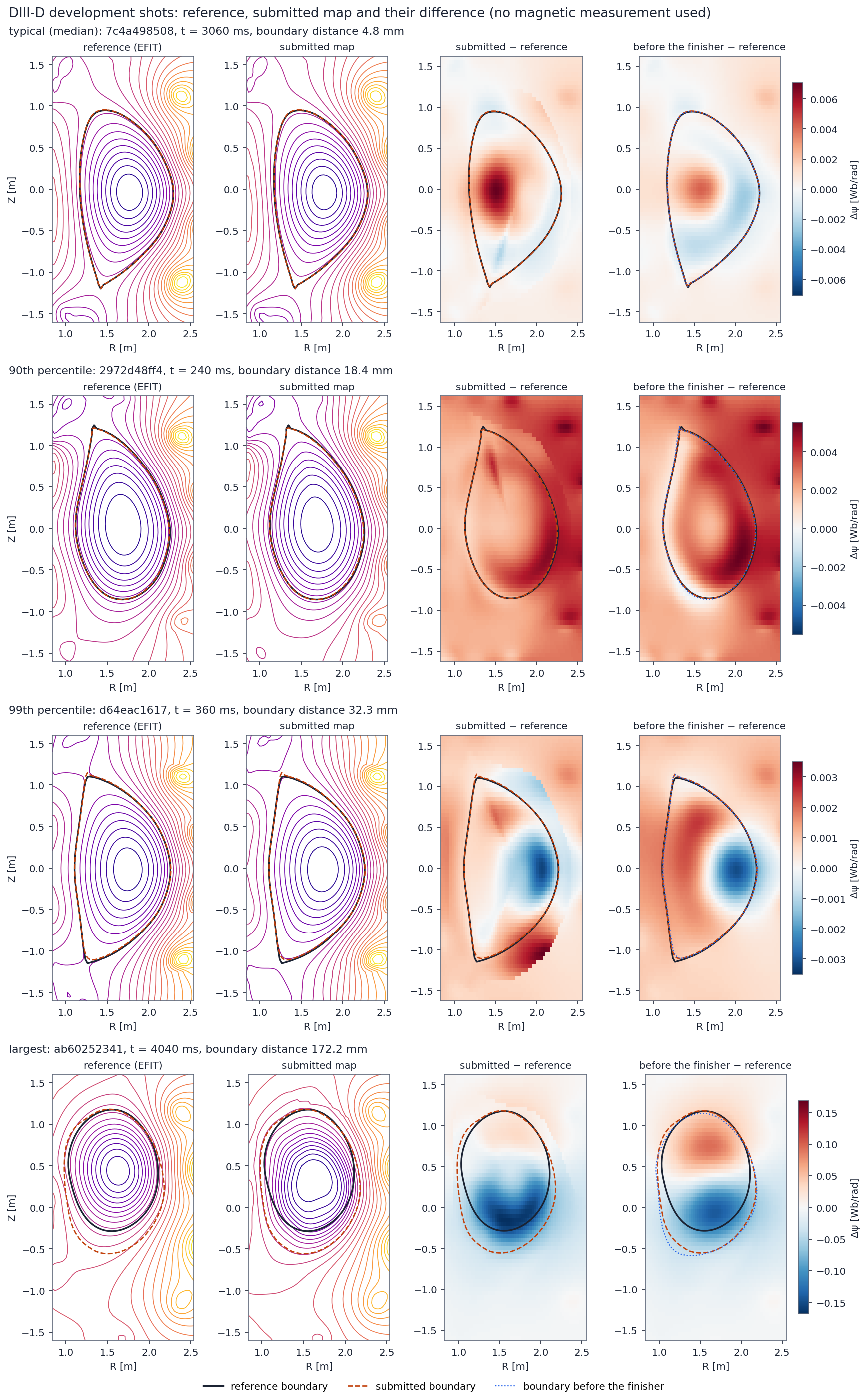
Four DIII-D development frames, chosen by a fixed rule (median, 90th and 99th percentile and largest boundary error): the reference, the submitted map and their difference. The evaluated networks were not fitted on these shots (Study §4.27).
Four findings
- Representation beat ensemble size. 215 features describing what the 0.5 ms input signals do within ±20 ms of each 20 ms frame let 32 refitted networks score higher than the 195-network ensemble before them: +1.98 × 10⁻⁴ on the public score, the largest single gain of the entry (Study §4.16).
- Most ideas did not help, and the record says by how much. Correctors, history models, new input forms, losses and finisher settings were measured on held-out shots and rejected (What did not work).
- A physics reconstruction without MAST labels reached 0.7145 on MAST, and label-free repairs confirmed on a synthetic testbed did not transfer to the real machine (Study §5.9).
- The finishing step trades equilibrium form for score. It adds 1981 µS of benchmark score on the development shots, while the share of current density that is not of Grad–Shafranov form, above the reference’s, grows from 0.35 % to 1.67 % and current appears outside the plasma (Study §4.27).
Read
- Methods report: the method in two pages.
- Accompanying study: what we tried, how we measured it, and what moved the score, including the many experiments that failed.
- Experiment ledger: one row per experiment, with the protocol checksum, the number and the decision.
- What did not work: the negative results by theme, with the numbers.
- What the entry cost: time, money, compute and energy.
The challenge
Rules and announcements: fusion-equilibrium-challenge.sophelio.io. Starter kit: Sophelio/fusion-equilibrium-challenge-starter. Data: Sophelio/fusion-equilibrium-challenge on Hugging Face. Platform: Codabench 17739.
Discuss
Discussions: open problems, reproduction questions and the negative results we kept.
Reproduce
Code, pinned environments, training and inference entrypoints: github.com/anulum/fusion-equilibrium-challenge. Weights: huggingface.co/anulum/fusion-equilibrium-challenge. Reproduce the Final submission: the exact commit, weight revision, input revision and output checksums. A first look in five minutes: the quickstart notebook in Colab.
On the hardware the entry was built on (two Intel Xeon E5-2640), the package reproduces the submitted predictions of both public folds bit for bit. On other CPUs the last bits of float32 can differ; the CI measures it on every push (q95 and βN identical, flux map within 7.5 × 10⁻⁹). All checks.
Cite as: doi:10.5281/zenodo.23480092. Code archived by Software Heritage (swh:1:snp:143cae236c490f64c48de43ca03761a9623e16d6).
Developed by Anulum (Miroslav Šotek) with Arcane Sapience, a research system of agents built on large language models. AGPL-3.0-or-later. Contact: protoscience@anulum.li.