SCPN Control — Neuro-Symbolic Fusion Controller
The Problem
Fusion energy is within reach, but real-time plasma control remains a bottleneck. Current tokamak control systems are:
- Slow — physics loops at 4--10 kHz, limited by Fortran/C legacy code
- Coupled — tightly bound to specific machines (DIII-D, ITER)
- GPU-locked — P-EFIT needs CUDA for sub-ms reconstruction
- No SNN path — no open-source Petri Net → SNN compilation for fusion
scpn-control addresses these with a different architecture.
The Solution
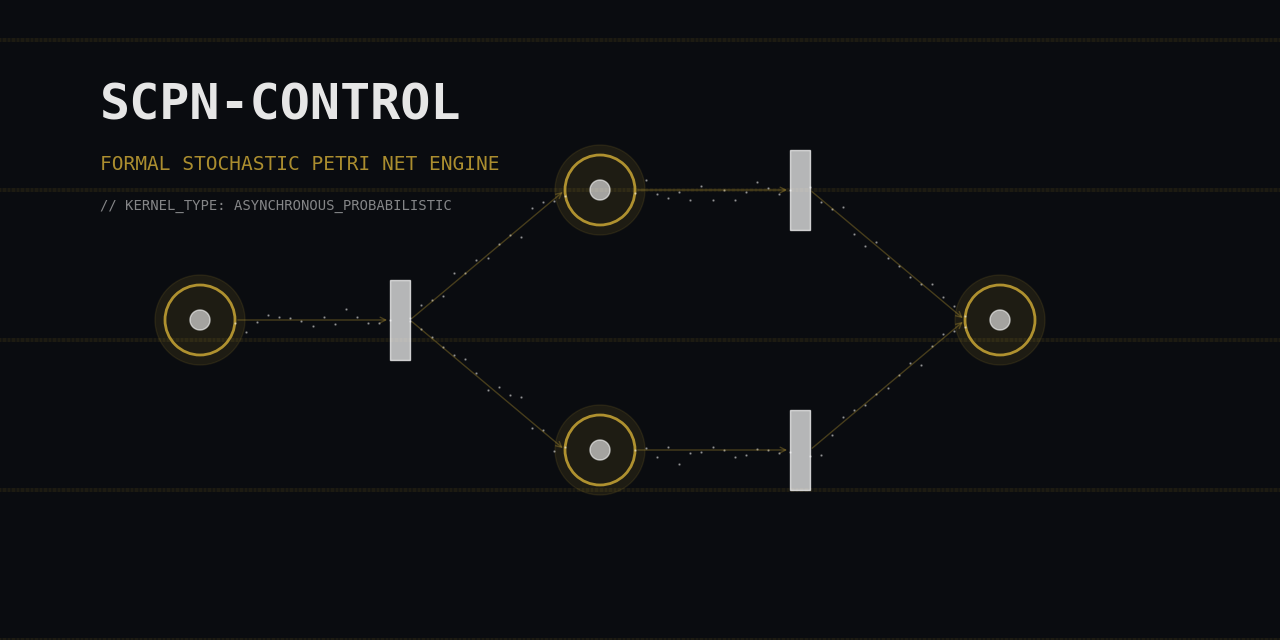
A standalone neuro-symbolic control engine that compiles Stochastic Petri Nets into spiking neural network controllers — with contract-based pre/post-condition checking, a runtime-selectable multi-controller stack, and zero GPU dependency.
What makes it different
The differentiator is the architecture, not raw speed:
- Petri Net → SNN compilation. A control specification written as a Stochastic Petri Net is compiled into leaky integrate-and-fire neuron pools — a documented open-source neuro-symbolic control path for fusion-control experiments.
- Runtime safety contracts on every action. Pre/post-condition contracts are asserted on every control observation and command, fail-closed; a separate bounded Z3 model check + certificate bundle covers the compiled Petri-net skeleton offline (not the controller code or physics).
- One interface, five controllers. PID, nonlinear MPC, normalized DGKF H∞, SNN, and a neuro-cybernetic controller share a single contract interface and are runtime-selectable, so the same safety case covers the whole stack.
- CPU-only, Rust-accelerated. No GPU dependency anywhere in the control path.
Real-time budget
Control compute is not the bottleneck. The native integrated control cycle runs
in ~5 µs P50 on CI (~3 µs local) — comfortably under the 1–10 kHz real-time
band (100 µs–1 ms period). In a fielded loop the dominant latency is diagnostics
acquisition, equilibrium reconstruction, and actuation, not the controller, so
this is reported as meeting the budget with margin, not as a competitive speed
claim. Per-controller and per-backend tables, with the local/CI side-by-side and
the acados-gated MPC caveat, are in benchmarks.
Neural equilibrium research path — without GPU
P-EFIT achieves <1 ms on GPU hardware. scpn-control's PCA + MLP surrogate
currently has bounded synthetic pretraining evidence, not an admitted latency
claim against P-EFIT on identical equilibria. The tracked pretraining report is
validation/reports/neural_equilibrium_pretraining.json; real EFIT/P-EFIT
latency or accuracy claims remain blocked until matched reference artefacts are
admitted.
Full-stack control in one package
| Capability | Status |
|---|---|
| Grad-Shafranov equilibrium solver | Tested (CI-gated RMSE) |
| 1.5D coupled transport | Tested |
| PID controller | Tested |
| Normalized DGKF H-infinity controller | Bounded-model tested |
| MPC (gradient-based, surrogate dynamics) | Tested |
| Spiking neural network controller (pure LIF+NEF engine) | Tested (mocked CI; Loihi untested) |
| Phase dynamics (Kuramoto/UPDE) | Tested |
| WebSocket live telemetry | Tested |
| Contract-based pre/post-condition checking | Tested |
| SPO reactor-regime assessment admission | Tested (review-only, abstaining profile) |
| Native linear GK eigenvalue solver | Tested (Cyclone Base Case) |
| External GK coupling (TGLF/GENE/GS2/CGYRO/QuaLiKiz) | Tested (mock subprocess) |
| Hybrid surrogate+GK validation | Tested (OOD + correction + online learning) |
| GK → UPDE phase bridge | Tested |
| ML disruption prediction (Transformer) | Experimental (synthetic data only) |
| SPI ablation mitigation | Experimental |
| Real-time digital twin | Experimental |
| Neuro-cybernetic controller | Experimental |
| JAX autodiff (transport + GS solver) | Tested |
| QLKNN-10D neural transport | Tested |
| PPO reinforcement learning agent | Research benchmark evidence |
| GPU dispatch (JAX) | Tested |
Why It Matters
For Fusion Startups
You need real-time control prototyping now, not after a 3-year bespoke development cycle. scpn-control gives you:
- A tested controller stack with module-specific tests, a 100% configured package coverage gate for admitted CI contexts, and CI-gated bounded validation
- Five-tier gyrokinetic transport research surfaces with strict boundaries for external-code agreement
- Runs on commodity hardware (no GPU or data center required)
- AGPL-3.0 open source; commercial licensing available
Caveat: This is Alpha-stage research software, not a production PCS. Integration with real hardware requires significant additional work.
For National Labs
scpn-control offers a modern alternative for offline analysis and rapid prototyping:
- Modern Rust + Python stack alongside legacy Fortran
- Contract-based pre/post-condition checking on control boundaries
- Digital twin for offline commissioning and algorithm development
For ITER / DEMO (Speculative)
The architecture could support future integration, but:
- Not currently hardened for ITER CODAC or EPICS
- Disruption prediction is trained on synthetic data only
- SPI mitigation physics is experimental, not validated against real disruption databases
Architecture
202 Python control/physics modules | 5 Rust crates / 65 Rust source files
583 Python test files | 22 GitHub Actions workflows
src/scpn_control/
+-- scpn/       Petri Net -> SNN compiler (formal contracts)
+-- core/       GS solver, transport, scaling laws, gyrokinetic (16 GK modules)
+-- control/    PID, MPC, H-inf, SNN, digital twin
+-- phase/      Paper 27 Kuramoto/UPDE engine (9 modules)

scpn-control-rs/
+-- control-types/    PlasmaState, EquilibriumConfig
+-- control-math/     LIF neurons, Boris pusher, Kuramoto
+-- control-core/     GS solver, transport, scaling
+-- control-control/  PID, MPC, H-inf, SNN
+-- control-python/   PyO3 bindings
Live Demo
Streamlit Dashboard: scpn-control.streamlit.app
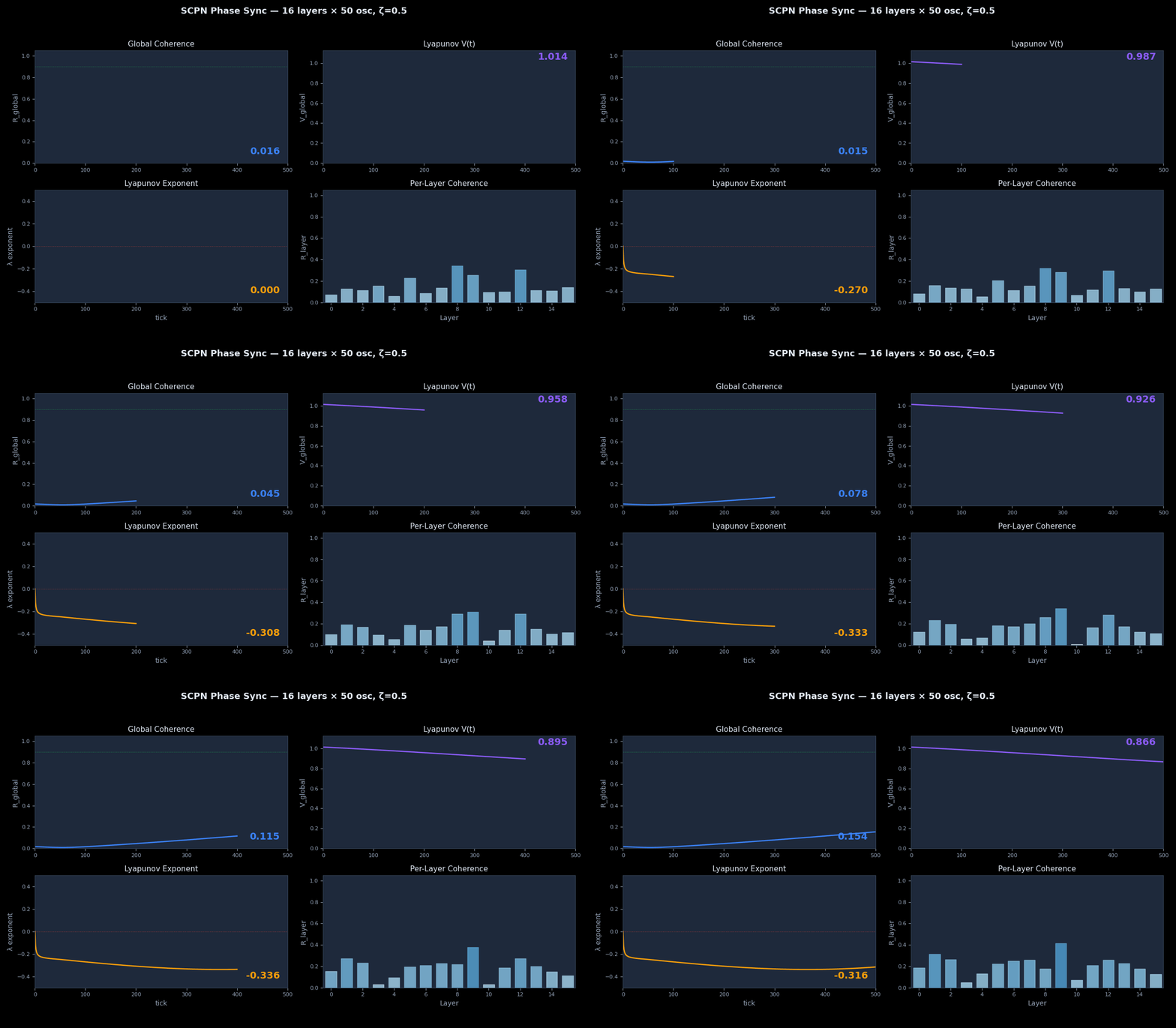
Real-time 16-layer Kuramoto-Sakaguchi phase sync with global field driver. Interactive controls for coupling strength, oscillator count, and Psi driver.
Phase sync convergence (500 ticks, 16 layers x 50 oscillators):
Validation
All benchmarks are CI-reproducible. See VALIDATION.md for scope and limitations.
| Validation | Method | Result | Data Source |
|---|---|---|---|
| DIII-D shot replay | Reference GEQDSK + disruption-shot archive, checksum gated | Manifest + replay gates pass | Immutable repository reference artefacts |
| SPARC equilibrium | 8 EFIT reference equilibria | < 5% flux error | Public GEQDSK files |
| IPB98(y,2) scaling | ITPA multi-machine database | 26.6% RMSE | Published coefficients |
| Kuramoto convergence | R -> 0.92, V -> 0, lambda < 0 | 500-tick verified | Simulation |
| Control latency | benchmark_native_handoff.py (P50/P99) |
~5 / ~6 us native cycle | CI (EPYC 7763) + local |
| Neural equilibrium | PCA + MLP synthetic pretraining | Claim boundary report tracked | Simulation |
Important: "DIII-D shot replay" is validated against immutable repository reference artefacts with manifest checksums. It is not a live MDSplus acquisition or facility-control claim. Synthetic fixtures remain only for CI plumbing tests and are not evidence for public physics claims.
Getting Started
pip install scpn-control          # From PyPI
scpn-control demo --steps 1000    # Closed-loop control demo
scpn-control benchmark            # PID vs SNN timing
scpn-control live --zeta 0.5      # Real-time WS phase sync
# Rust acceleration (optional)
cd scpn-control-rs
cargo test --workspace
cd crates/control-python && maturin develop --release
Publications
- Paper 27: "The Knm Matrix" — 16-layer Kuramoto-Sakaguchi phase dynamics with exogenous global field driver. Paper 27 manuscript.
- Related Kuramoto-Sakaguchi finite-size reference: arXiv:2004.06344.
- Competitive Analysis: Full benchmark comparison against DIII-D PCS, TORAX, FUSE, GENE, JINTRAC, P-EFIT
Licensing
| Open Source | AGPL-3.0-or-later (strong copyleft); commercial licensing available |
| Contact | protoscience@anulum.li |
| Organization | ANULUM CH & LI |
| Authors | Miroslav Sotek (ORCID) |
Evaluation entry points
- Try it:
pip install scpn-control - See benchmarks: Competitive Analysis
- Live demo: scpn-control.streamlit.app
- Talk to us: protoscience@anulum.li
Decision-context guide for this pitch
This document presents the technical value of the stack and the market position. For external communication, use this map:
- What the platform proves today: bounded controller execution, contract-admitted validation workflow, and benchmark evidence in its declared context.
- What it does not prove yet: facility commissioning equivalence, measured-shot deployment claims, and CODAC/EPICS production acceptance.
- What to state when pitching: separate local/controlled benchmarks from hardware deployment claims.
A practical investor-facing summary should pair this page with:
docs/production_readiness.md(admission gates and limitations),docs/validation.md(validator outputs and claim boundaries),docs/benchmarks.md(timing context and evidence classes).
If a claim depends on external-code or facility validation, state that the corresponding evidence is absent rather than presenting it as completed work.
Practical use and scope
Use this page as an investor-facing description of the current product surface.
- Verify measurable statements against the linked evidence artifacts.
- Read local timing separately from hardware and facility admission.
- Use the contact link for technical review or collaboration enquiries.