SYNAPSE CHANNEL
The local-first coordination bus for fleets of AI agents.
Flagship example: coordinate parallel AI coding agents through declared file scopes — the hub refuses a second overlapping live claim, while covered provider hooks and the staged Git gate enforce only their documented mutation boundaries.
A local-first coordination bus for a fleet of AI agents working in parallel — within one codebase or across a whole ecosystem of them. A single WebSocket hub is the authoritative source of truth for presence, file-scoped work claims, chat, task status, a shared plan, agent capabilities, and resource offers, so agents spread over many projects can see conflicting or duplicate declared work before acting.
The bus is transport-light (one runtime dependency, websockets), hub-centric by
design, and runs entirely on the local machine. Model workers reply on-channel
through any OpenAI-compatible endpoint, including a local Ollama server, with a
deterministic rule-based fallback for offline use.
New here? Read Why SYNAPSE CHANNEL — a five-minute read on what it is, what you build on it, how it differs from the tools next to it, and why coordination is the bottleneck once you run more than one agent.
Current 0.x releases are pre-1.0 development releases. 1.0.0 is planned as
the first stable commercial release of SYNAPSE CHANNEL, with stable operational
contracts, support surfaces, and commercial licensing terms documented for that
line. SYNAPSE CHANNEL is seeking startup funding, strategic partners, and aligned
ecosystem co-owners; see Commercial licensing for the evaluation
and contact path.
Current 0.x releases do not promise backward compatibility across minor
releases. Pin an exact package version when an integration needs a fixed target,
and review API and wire stability plus the
0.x to 1.0 migration guide before upgrading.
Why a coordination bus
When several agents work across your repositories at once they need a shared, authoritative view of who is doing what. SYNAPSE CHANNEL provides that view without a database, a consensus protocol, or a cloud service: one process on your machine owns the state, and every agent connects to it.
What it gives you
- Work claims with file-scope overlap detection, expiring leases, and epochs.
- Crash-durable persistence (append-only SQLite WAL with replay) and reconnect-safe idempotency.
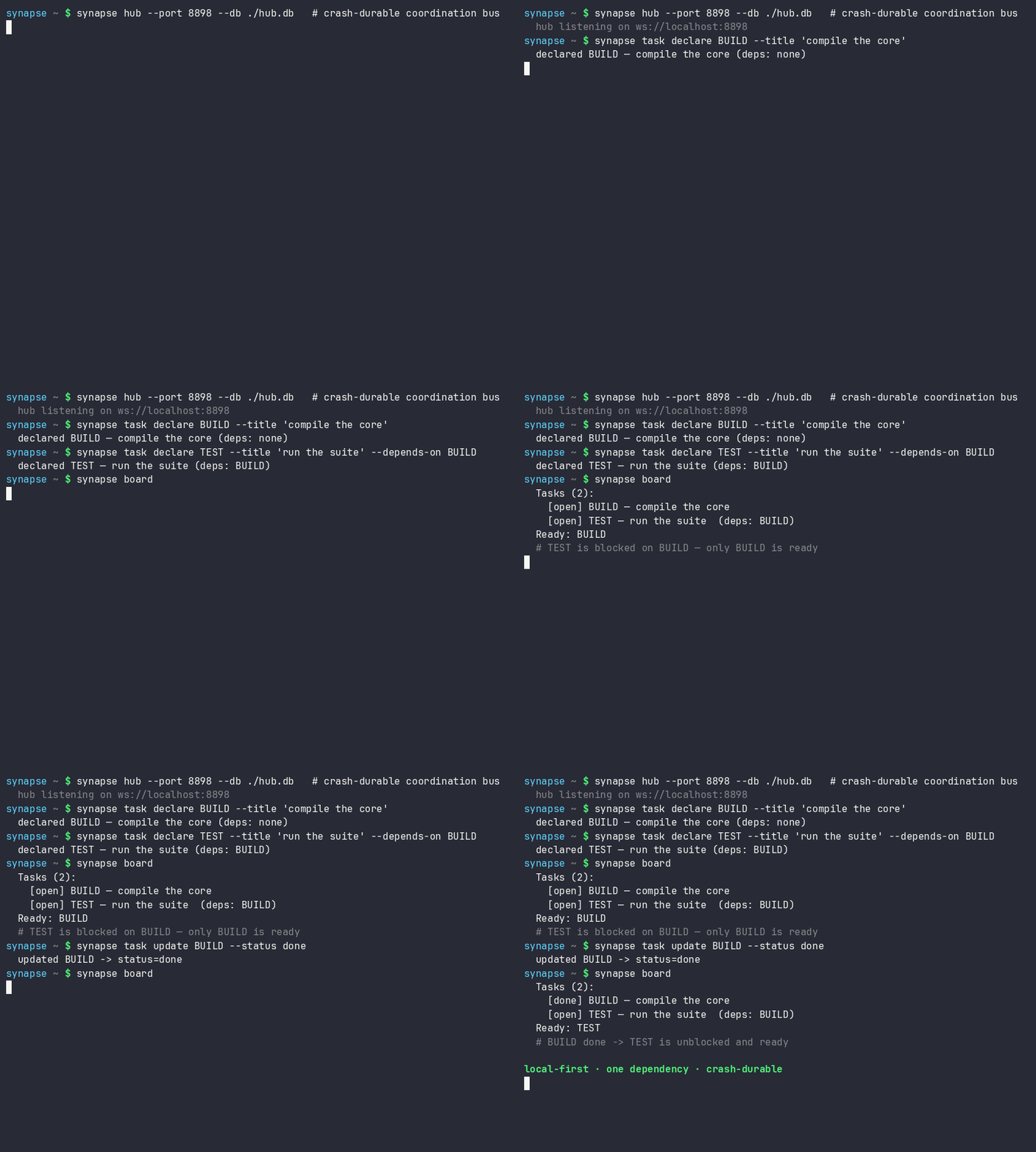
- A typed task lifecycle, deadlock detection, and a shared blackboard of declared tasks with dependencies and an append-only progress stream.
- Atomic handoff, an LLM-free stall supervisor, and resumable checkpoints.
- Proportionate connect authentication and task-class routing to tiered backends.
- Direct messaging — broadcast, a named group (
A,B), or one agent — with a per-agent inbox an idle agent catches up from the durable feed. - A command line for the whole flow (
synapse hub/worker/team/send/listen/
  relay/board/supervisor/manifest/task
) and runnable examples.
Client paths: supported first
The hub speaks one wire protocol, but not every client surface carries the same support weight. Choose in this order:
- Supported core — the paths fleets should build on today: the hub itself
and the
syn-*/synapseCLI (the complete flow above), release-gated and covered by the API and wire stability contract. - Shipped adapter — the MCP server face for MCP hosts such as Claude Code, Codex, Cursor, and Claude Desktop: release-gated and fully tested; classified as an adapter, so the stability contract freezes its named boundaries rather than the whole surface.
- Validated, partial interop — the A2A bridge: the official SDK completes discovery and the send/get/list/cancel lifecycle against it, and the official TCK HTTP+JSON MUST run records 55 passed with 5 documented gaps — recorded evidence, not certification. The Go and JS clients embed within their stated boundaries.
- Experimental — the cockpit PWA and the installable VS Code extension preview: useful, moving fast, and not part of the stability contract. Expect surface changes between minor releases.
Coming: Studio
The read-only dashboard is growing into an operator Studio — a
control plane that answers, at a glance, what is happening, what is at risk, and what
is safe to do next. The instrument-panel design system, /studio reference page,
live /studio/command shell, security-posture panel, and event-log LiveFeed have
shipped. Local-first and read-only by default.
Next steps
- Installation · Quick start · Tutorial
- Coordination model · Policy engine · Agent trust graph · Identity and ACL
- Wire protocol · API and wire stability · 0.x to 1.0 migration · CLI reference · Recipes · Examples
- Deployment
SYNAPSE CHANNEL is AGPL-3.0-or-later with a commercial licence available. See the
project's NOTICE.md.